

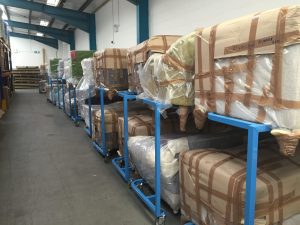
One issue that high street clothing companies face comes at the end of a fashion season, when many clothing items are stored on heavy duty storage rails and cannot be sold in the retail shops.
Known as ‘dead stock’, these items can be sold at discount prices to surplus chains like TK Maxx, and some may end up in charity shops, but many companies admit that they destroy unsold clothing. Some charities sell on clothing abroad, but so much is being exported that supply exceeds demand.
In The USA, Refried Apparel has found a solution for dead stock. The company buys surplus clothes at low prices and transform them into new original garments by adding printed logos, graphics, and sew on patchwork patterns of materials. Mark Litos co-founder of the company poetically describes this process as:
“We take their coal and we turn it into diamonds.”
The company specialises in recycling sports clothing. If a team changes its tops, last season’s clothes will be taken by Refried Apparel who redesign them. British football teams regularly change their kits and, this could be a way to recycle old kits.
The founders of Refried Apparel, Lisa and Mark Litos, say they are solving a problem by helping retailers and wholesalers with the issue of dead stock taking up space on warehouse garment rails. They regard their company as green up-scalers
Refried Apparel does not operate in Britain but their business model could be the solution for dealing with excess clothing stock.
You may also interested in:
Innovative ways needed to handle non-conveyable inventory
Due to an increase in e-commerce sales, warehouses are handling much larger volumes of large, heavy and irregularly shaped items known as
Predictive technology cuts warehouse accidents and breakdowns
Warehouse safety technology is moving beyond the traditional reactive model towards