

In busy warehouse environments, material handling counts for a lot. It is central to productivity and a smooth workflow, not to mention safety.
A warehouse trolley’s primary purpose is to move bulky goods, but trolleys come in a range of designs suited to different tasks.
This article provides an overview of the most widely used types of warehouse trolley, and talks about their ability to support specific handling needs. Get to grips with the various trolley types, and you can pick the right equipment for your workflow and environment.
Types of warehouse trolleys
Below are eight of the most common types of warehouse trolleys, including their key features and typical uses:
Platform trolleys
Platform trolleys are one of the most versatile material-handling tools found in warehouses, as well as factories and retail environments.
They consist of a flat load bed and a handle for pushing or pulling, making them ideal for transporting many items. Platform trolleys are suitable for carrying boxes, crates, furniture and bulky goods.
There are many variants of platform trolleys, including folding models that save space when not in use, and flatbed styles designed for heavy industrial loads. They are simple, durable, and adaptable.
Sack trucks
Sack trucks are also known as sack barrows. These two-wheeled manual trolleys are designed for moving tall, heavy, or awkward items.
They have a classic L-shaped design that allows the operator to slide the base plate under a sack, crate or box and then tilt the load back onto the wheels. This way, strain is reduced on the user and lifting is safer.
Sack trucks are used for feed sacks, stacked boxes, bottles, and other bulky items that might be difficult to move with a flatbed trolley.
Order picking trolleys
Order picking trolleys are designed to make the order-picking process faster and more efficient. They come with multiple shelves, baskets, or compartments. This structure allows workers to collect several items at once while moving through warehouse aisles.
They come in a variety of configurations. There are lightweight models for small parcels and heavy-duty designs for larger orders. Order picking trolleys help to economise movement around the warehouse floor and reduce unnecessary trips. In environments with a high volume of small-to-medium products, they can be a massive help.
Cage trolleys
Cage trolleys – also known as roll cages or roll pallets – feature a sturdy cage-like frame that keeps items secure during transport. They can be open-sided or fully enclosed, depending on the level of containment required. These trolleys are invaluable in environments where goods need to be moved without risk of falling, such as in retail stock replenishment, supermarkets, and distribution centres. Cage trolleys also improve security by making theft or accidental loss less likely during movement.
Pallet trucks
Pallet trucks are specifically for moving palletised loads across short distances. They are manually operated vehicles that slide their forks underneath a pallet. Using a hydraulic pump, the load is lifted slightly off the ground.
Widely used for loading and unloading deliveries, pallet trucks transport stock across floor areas, and support warehouse operations where goods are usually stored in pallets. This is another trolley type which is indispensable in many warehouse settings.
Dollies
Dollies have low-profile platforms with wheels. They are used to move heavy, bulky and irregularly shaped items.
Ideal for transporting items that may not fit securely on a traditional trolley, dollies can be used in tandem with handling equipment such as pallets or vehicles. Items can be moved onto a dolly first, before they are transferred to another piece of equipment. Dollies are used in heavy-duty exercises within manufacturing and logistics.
Shelf and bin trolleys
Shelf and bin trolleys feature multiple shelving levels or integrated bins. This allows workers to transport several small items or components at once.
These trolleys can be useful for stock management, parts distribution, and kitting tasks. Because they are organised and compartmentalised, they can be ideal for maintenance teams and personnel working on assembly lines.
Scissor lift trolleys
Scissor lift trolleys incorporate a scissor-lift mechanism, raising and lowering the platform as needed. This design reduces or negates manual lifting.
They are often utilised for loading or unloading heavy items or positioning materials at a comfortable working height.
Scissor lift trolleys are common pieces of equipment in many warehouses, workshops and manufacturing lines, workshops, and warehouses which require heavy handling.
You may also interested in:
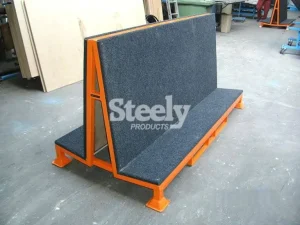
Factors to consider when choosing between a mobile and static A-frame
A-frames are valuable solutions for a range of operating environments and are often deployed in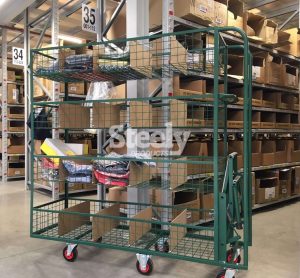
What is the difference between a stillage and a trolley?
A stillage and a trolley are both widely-used storage and transportation solutions in warehouses, factories and retail distribution environments. We’ll use this article to break down the difference between the