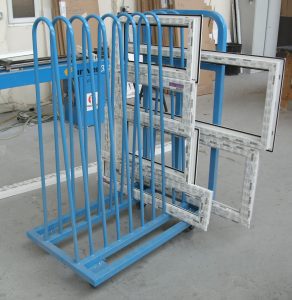
A stillage and a trolley are both widely-used storage and transportation solutions in warehouses, factories and retail distribution environments.
We’ll use this article to break down the difference between the two products, looking at how they work, as well as their purposes and functions. This will help you to choose the best option for your operation.
First, let’s be clear on the definition of each product:
What is a stillage?
A stillage is a storage unit typically made from steel, designed to hold goods securely in one place.
Stillages can be static or semi-static, and are usually stackable. They are moved using mechanical handling equipment such as forklifts or pallet trucks, rather than by hand. Stillages are used for storing heavy, bulky, or awkwardly shaped items and are utilised in manufacturing, construction, warehousing, and logistics environments.
What is a trolley?
A trolley is a mobile handling solution that is moved manually by operators. They come in many shapes and sizes, and have various purposes.
Common to all trolleys are castors or wheels, which allow them to transport goods easily across floors, to and from storage areas, and between dispatch points.
Among the most commonly used trolleys in commercial and industrial environments are shelf trolleys, A-frame trolleys and platform trolleys. Each is more suited to specific loads, based on the size, weight, shape and type of the items.
Differences between a stillage and a trolley
Here we put the spotlight on what makes these two products different:
Mobility
A major difference is mobility. Stillages are typically stationary and require machinery to move, whereas trolleys are designed for easy manual movement. For this reason, trolleys are better suited to the frequent transportation of goods.
Design
Stillages are designed for their strength and stackability, whereas trolleys are made to be manoeuvrable, with wheels and handles for safe pushing and steering. and designs that support safe pushing and steering.
Function
While stillages are primarily used for storage and bulk handling, trolleys are intended for transport and picking tasks.
Uses
Stillages are ideal for holding stock or goods in fixed locations. In contrast, trolleys can be the best solution for moving items across a worksite or retail space.
You may also interested in:
What are the different types of warehouse trolleys?
In busy warehouse environments, material handling counts for
What is the difference between storage racks and storage trolleys?
Enterprises that store and handle stock in sites like warehouses and logistics hubs need dependable solutions to