Can wet weather cause clothes to grow mould in a warehouse?
29/10/2026 by Fenton Richardson
Storing goods safely and effectively is critical for operations like warehouses. From products that have a quick turnaround to slow sellers and overstocked items, it is essential that inventory is protected so it retains its commercial value. When products become damaged, they can no longer be sold and must be written off, impacting the bottom line of storage facilities.
Every type of goods comes with its own unique storage challenges. An obvious instance is fragile items like glassware that can easily become broken if handled and kept carelessly. However, some harm to inventory is more subtle and can happen slowly, often going unnoticed until it’s too late. When commercial textile and fabric items like clothing are stored in damp conditions, they can start to grow mould, ruining their worth.
Unfortunately, this can easily occur in the UK, where wet weather is a common occurrence. In this in-depth article, we’ll explore how excessive moisture from precipitation can lead to clothing developing mould and fungal growth. We’ll also offer some best practices to avoid this unwanted issue.
How does wet weather cause mould to grow on clothes?
Wet weather can cause mould and fungal growth in warehouses because rain and high outdoor humidity raise indoor moisture levels, making the air stagnant. Wet air outside can cause indoor relative humidity to rise to over 60 per cent in warehouses.
While stored plastic, glass and stainless-steel products can easily be wiped dry when this happens, the same can’t be said for clothing. Garments, especially those made with natural fibres such as linen, cotton and wool, absorb water vapour present in humid air. This means that even if a warehouse is completely waterproofed against leaks, fabric can get damp.
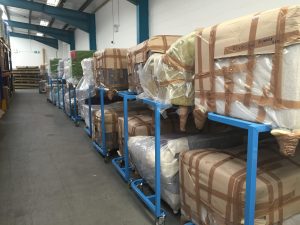
When warehouses lack effective ventilation systems, the heavy air filled with high levels of moisture becomes trapped in between storage solutions like rails, pallets and cartons of packed clothes.
When the weather is both cold and wet, the exterior of warehouses becomes chilled. When warmer indoor air interacts with these cold surfaces, condensation forms and any clothes touching these damp fixtures take on the water.
Damp clothes quickly become a breeding ground for mould to thrive in because they provide the optimal combination of moisture, stagnant air and food sources (natural fibres) that microscopic fungi require to grow and multiply.
How do you prevent mould growth in warehouses where garments are kept?
The good news is that preventative measures exist to inhibit mould growth in warehouses working under wet weather conditions.
A proactive approach is to regularly monitor humidity levels on site. Operators should ensure that the relative humidity of the warehouse always stays below 60 per cent. This can be achieved using appropriate heating, ventilation and air conditioning (HVAC) controls and professional-grade equipment like industrial dehumidifiers.
On a more practical level, there are simple but effective ways to improve airflow around warehouses. Materials handling teams should always leave sufficient space between shelving units, rails and pallets, and between these and exterior walls to guarantee that air can circulate freely around stored clothing.
When garments are kept in warehouses, they should never be sealed inside airtight plastic covers when humidity is high, as the plastic will trap condensation inside. Covers made from breathable materials should be employed instead.
Do you need effective solutions to solve mould problems impacting your inventory?
At Steely Products, we specialise in supplying warehouses and other storage facilities with the equipment they need to succeed. Along with supplying durable shelving options and dedicated clothes rails, we also provide garment rail covers. These purpose-built solutions are ideally suited for use in damp areas when wet weather impacts warehouse conditions. Made with soft-touch polypropylene and featuring a zip closure for easy access, they can keep clothes free from mould.
Connect with our experienced team today to learn more about the innovative products we provide.
You may also interested in:
AI-powered scheduling software increases staff retention
Legion Technologies in California has developed a workforce management platform that gives staff more
Energy specialist highlights potential warehouse benefits of solar panels
The chief marketing officer at renewable energy company Wattstor, Amy Wilson, has asked why so many warehouse spaces are